


From a Lump of Clay to a Ceramic Pot: A Journey Through Fire
Imagine a potter taking a lump of soft clay and placing it on a wheel. Perhaps it will become a mug. Perhaps a plate. Perhaps a vase.
At this moment, it is simply clay.
It contains minerals, tiny particles, air and a considerable amount of water. That water is what allows the clay particles to move past one another, giving the clay the plasticity needed to shape it.
The potter finishes the piece and places it carefully on a shelf.


The first transformation happens outside the kiln
The freshly made piece is left to dry slowly. Perhaps it sits on a shelf in the potter’s studio, protected from direct sunlight but with enough air moving around it.
Why not put it directly under the sun? Because the clay does not dry from the inside and outside at the same rate. The exposed surface loses water first. As water leaves, the clay particles move closer together and the piece shrinks. If the outside dries and shrinks much faster than the inside, stresses develop within the piece.
A plate can warp. A handle can crack where it joins a mug. A thick vase can split. So potters generally aim for slow and even drying rather than simply the fastest possible drying. Shade helps slow the process down and reduce the temperature difference between different parts of the piece. Direct sunlight, especially combined with hot, dry air, can make the surface dry much faster than the interior.
The clay is shrinking as it dries. Take a 10 cm × 10 cm piece of clay. If that particular clay body has a drying shrinkage of 6%, that 10 cm dimension could become approximately: 10 cm → 9.4 cm. The actual number depends heavily on the clay body and how much water it contains.
Eventually the piece becomes completely dry. It is now called greenware. It looks like pottery. It feels hard. But it is still clay. If you put it in water, it can eventually return to its original plastic state.
Now it is ready for the kiln.
Into the kiln
Our little mug is carefully placed inside the kiln. The kiln does not immediately leap to 1,000°C. The temperature rises gradually.
At first, the kiln is still dealing with something very familiar: water.
Around 100°C: water leaves the clay

As the temperature rises, remaining free water inside the clay becomes vapor and escapes through the tiny pores in the piece. At approximately 100°C, water can boil and turn into steam. This is why completely dry greenware matters. If moisture is still trapped deep inside a thick piece, heating it too quickly can cause steam pressure to build faster than it can escape. The result can be cracking—or, in severe cases, an explosion.
So the beginning of the firing is deliberately gentle.
Is the clay still shrinking? Yes, but most of the major drying shrinkage has already happened before the piece entered the kiln. There can still be some dimensional change as remaining physically held water is removed, but this is much smaller than the shrinkage that occurred while the clay was drying from wet to bone dry.
The kiln is now beginning a different kind of transformation. It is no longer simply drying the clay. It is beginning to change the clay itself.
Around 200°C: the last of the easily removable moisture leaves
Our mug continues to heat. Although we often think of water as simply “boiling at 100°C,” water inside a porous clay body does not all behave as if it were sitting in an open pot. Some moisture is held more tightly to the clay particles. As heating continues, more of this physically held water is removed.
There may still be some shrinkage and contraction during this part of the firing, but again, it is not the dramatic shrinkage we saw during drying. The clay is getting hotter. And the really important transformation is approaching.
Around 450–600°C: the clay itself begins to change
Now we reach a major turning point. Some of the water in the clay isn’t simply sitting between the particles. It is part of the structure of the clay minerals themselves. As the temperature rises, this chemically bound water is driven out.
This process is called dehydroxylation.
The clay minerals begin to lose their original structure and transform into new mineral phases. This is a permanent change.
Before firing, if our dry clay were soaked in water long enough, it could become workable clay again. After this transformation, that is no longer possible.
We have crossed an important boundary. The clay is becoming ceramic.
Around 573°C: the quartz inside takes a small step
At approximately 573°C, quartz undergoes a change in its crystal structure known as quartz inversion. This causes a small but relatively rapid change in volume. When the kiln later cools back through this temperature, the quartz changes back.
This is one reason controlled heating and cooling are important in pottery. The piece is not simply getting hotter and hotter. The minerals inside it are changing, expanding, contracting and reorganizing as the temperature changes.
Around 600–900°C: clay becomes something new
The temperature continues to climb. Organic materials burn away. Gases escape. The original clay minerals continue to transform.
And then something fundamental begins to happen. The tiny clay particles begin to bond together. This process is called sintering.
The piece becomes harder and stronger. It can no longer be turned back into clay simply by soaking it in water. At the end of an appropriate first firing, our mug has become bisque ware.
And this is an interesting point in the journey because the story doesn’t necessarily have to continue. Bisque ware can already be useful
Think about the traditional clay pots that have been made and used for generations. Cooking pots. Water pots. Storage vessels. Flower pots.
Many traditional ceramic vessels are essentially unglazed, porous fired pottery. They retain the natural color and character of the clay. They can be perfectly functional without ever receiving a layer of glaze.
In fact, the porosity of an unglazed pot can sometimes be useful. A porous water vessel, for example, can allow a small amount of water to migrate through its walls and evaporate from the surface, helping cool the water inside. A flower pot can benefit from allowing excess moisture to escape. Unglazed pottery can therefore be the finished product.The potter does not necessarily need to go any further.
But what if we want something different? What if we want a mug that is easier to clean? A plate that doesn’t absorb liquids? A decorative piece with a blue, green or glossy surface? A vessel with a surface that is much less porous?
Then our journey continues. We glaze it.
The next stage: glazing
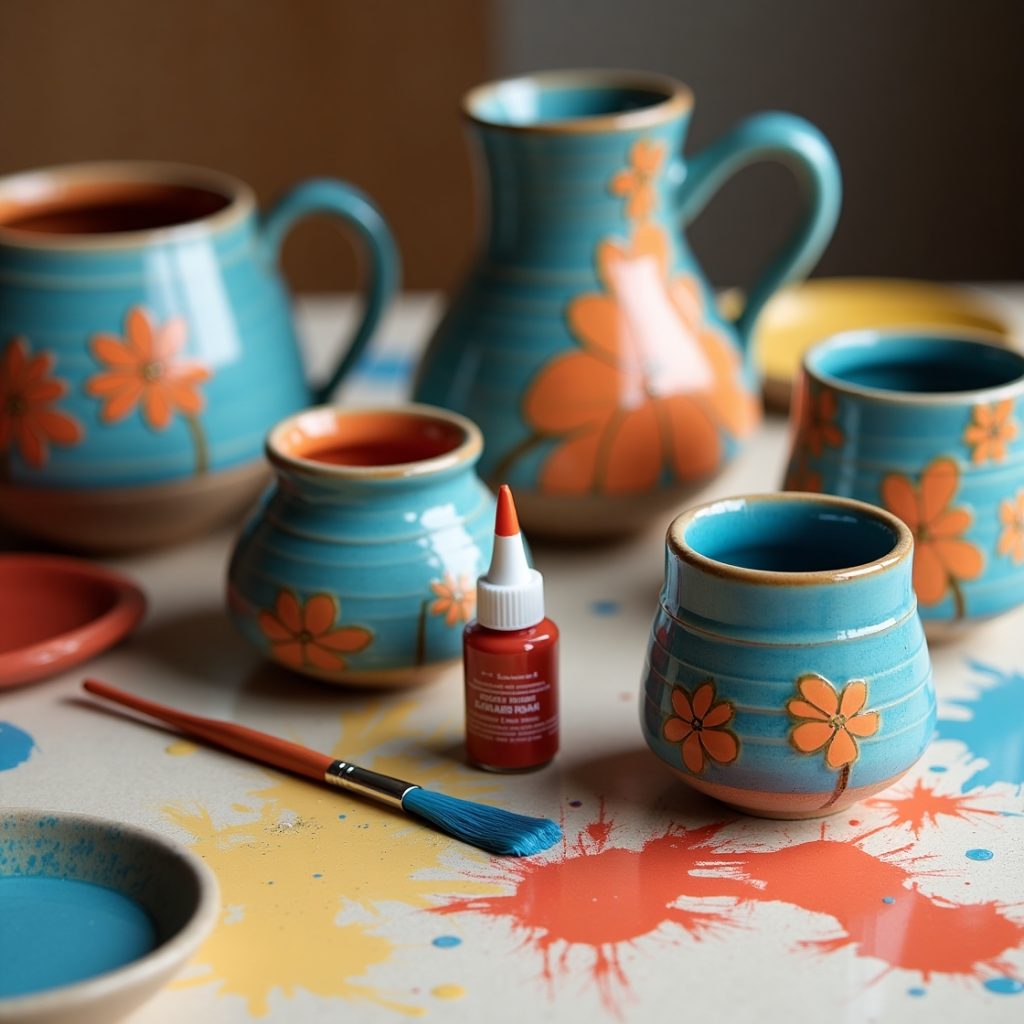
The bisque-fired piece is now hard and porous. This porosity is actually useful. When glaze is applied, the porous surface helps hold the glaze suspension in place. The potter may dip the mug, pour glaze over it, brush it on or spray it. And now the piece goes back into the kiln. This is the glaze firing.
But something important has changed. The second firing isn’t just about making the clay ceramic. The clay is already ceramic. Now we are also trying to make the glaze melt and mature while bringing the clay body to its intended maturity.
What happens to the glaze?
Glaze may look like coloured powder mixed with water when it is applied. But inside the kiln, it undergoes a remarkable transformation. As the temperature rises, its ingredients begin to react. Some materials melt. Others dissolve into the developing glassy phase.Eventually the glaze becomes a molten or semi-molten glass-like layer covering the surface of the ceramic.
Then the kiln cools. The glaze solidifies. And the surface that was once a dull powder becomes glossy, satin, matte, textured or brightly colored depending on its formulation. Now our mug has completed another stage of its journey.
Clay → greenware → bisque → glazed ceramic.
But there is no single “ceramic temperature”
This is perhaps the most important lesson of the whole journey. There isn’t one temperature at which clay suddenly becomes ceramic. Different clay bodies mature at different temperatures.
Some earthenware bodies are designed for relatively low firing temperatures. Stoneware bodies generally require higher temperatures. Porcelain is typically fired at still higher temperatures. And glazes have their own firing ranges.
This means that the potter has to think about the whole system:
Clay + glaze + firing temperature + firing schedule
A glaze designed for 1,200°C is not automatically suitable for every piece of clay. And a kiln capable of reaching 1,300°C doesn’t mean every clay body should be fired to 1,300°C. The goal is not simply to make the kiln as hot as possible. The goal is to take this particular clay body through the right journey.
From a lump of earth to a finished object
Our little lump of clay began as a soft, wet material that could be shaped by hand. It sat on a shelf for days while water slowly left it. It became greenware. Then it entered the kiln. Water left. Organic materials burned away. Clay minerals changed. Particles began bonding. The clay became bisque.
At this point, it could already become a useful unglazed pot. But if we wanted color, a less porous surface or a particular finish, we continued the journey. We added glaze. We fired it again. The glaze melted and transformed into a glass-like surface. And finally, after the kiln cooled, we opened the door. The soft lump of earth we started with had become something entirely different: a ceramic object.
And that is the remarkable journey hidden inside every cup, plate, vase and pot we make from clay.
Understanding this journey helps you choose the right clay, glaze, firing temperature and ceramic equipment for the result you want.
Whether you are making traditional earthenware, pottery for everyday use, decorative ceramics or exploring higher-temperature firing, having access to the right tools and materials makes the process easier.
If you’re looking for pottery supplies in Kenya, Handmade Soko brings together equipment, materials and tools for makers, including pottery kilns, ceramic glazes, clay and other craft supplies.
Explore our ceramics and pottery listings to find equipment and materials available to makers in Kenya, or browse the Handmade Soko marketplace to discover suppliers and service providers who can help you take your next piece from clay to ceramic.